Monday, December 18, 2017

There came wise men from the east

Advent 2017 The Christmas Story in Matthew 1 & 2


1 When Jesus was born in Bethlehem of Judaea in the days of Herod the king – and now for the rest of the story!

there came wise men from the east- funny how we want to automatically add three. There could have been three, but to be honest, Matthew doesn’t say how many wise men came.

Wise men – the word is μαγοι (plural of μαγος) which we transliterate magi. The name given by the Babylonians, Medes, Persians, and others, to the wise men, teachers, priests, physicians, astrologers, seers, interpreters of dreams, soothsayers, sorcerers. It occurs twice in the Old Testament - LXX Daniel 2:2 & 10; translated magicians; six times in the New Testament - four times in Matthew 2; twice in Acts 13. It is wise men in Matthew and sorcerer in Acts 13, where he is also described as a false prophet.

“ "The Jews believed that there were prophets...who were of the posterity of Abraham by Keturah; and that they taught...what they had received in tradition from the mouth of Abraham." - Whitby. These, knowing the promise of the Messiah, were now, probably, like other believing Jews, waiting for the consolation of Israel.” (Clarke)

we have seen his star in the east – I’m persuaded these magi knew the ancient prophecy in Numbers 24:17 (LXX)
I will point to him, but not now; I bless him, but he draws not near: 
a star shall rise out of Jacob, a man shall spring out of Israel; and shall 
crush the princes of Moab, and shall spoil all the sons of Seth.

Where is he that is born King of the Jews? – they arrived in Jerusalem and got straight to the point!

3 When Herod the king had heard these things, he was troubled, and all Jerusalem with him.
When Herod heard of the arrival and question of the wise men he was troubled. He was disturbed, distressed, and probably afraid. I mean, the King of the Jews has been born and he is on his way out. Isn’t it interesting how people react to Jesus? Salvation has come and all he can think about is how he will lose his position and power.
I get why Herod is troubled, but why all Jerusalem with him? It is the same result but for different reasons. Herod was disturbed, disquieted, filled with dread, but I believe all Jerusalem was full of inward commotion so that they lost all calmness of mind – “What is this? Messiah has been born? Has this really happened? What will this mean? What’s going to happen?” It is one thing to say you want the Messiah to come, it is another thing to be ready for his advent. This explains why John’s message was Repent.

"An ancient and settled persuasion prevailed throughout the east, that the fates had decreed some to proceed from Judea, who should attain universal empire." Suetonius

"Many were persuaded, that it was contained in the ancient books of their priests, that at that very time the east should prevail: and that some should proceed from Judea and possess the dominion." Tacitus  (both quoted by Clarke)

4  And when he had gathered all the chief priests and scribes of the people together, he demanded of them where Christ should be born. - Oh, now all of a sudden Herod wants to know where the Christ is to be born.

5  And they said unto him, In Bethlehem of Judaea: for thus it is written by the prophet,
6  And thou Bethlehem, in the land of Juda, art not the least among the princes of Juda: for out of thee shall come a Governor, that shall rule my people Israel. - They know their Bible and without hesitation they quote Micah 5:2

And thou, Bethleem, house of Ephratha, art few in number to be reckoned among the thousands of Juda; yet out of thee shall one come forth to me, to be a ruler of Israel; and his goings forth were from the beginning, even from eternity. (LXX)

It’s not clear what version they were quoting or if they slightly paraphrased it, but this much is clear, they believed this referred to the Messiah – “Where is he to be born?? Bethlehem.” It is interesting where they stopped, for the last part is enlightening, and his goings forth were from the beginning, from eternity. The LXX used two different words for from and Adam Clarke highlights this:

from the beginning - In every age, from the foundation of the world, there has been some manifestation of the Messiah. He was the hope, as he was the salvation, of the world, from the promise to Adam in paradise, to his manifestation in the flesh four thousand years after.

from eternity - That is, there was no time in which he has not been going forth in various ways to save men. And he was before that time in which he began to come forth to save the souls that he had created. He was before all things. As he is the Creator of all things, so he is the Eternal, and no part of what was created. All being but God has been created. Whatever has not been created is God. But Jesus is the Creator of all things; therefore he is God; for he cannot be a part of his own work.

7  Then Herod, when he had privily called the wise men, enquired of them diligently what time the star appeared. 8  And he sent them to Bethlehem, and said, Go and search diligently for the young child; and when ye have found him, bring me word again, that I may come and worship him also. - Herod is up to no good. He’s putting on a show of genuine spiritual interest, but all of this is flowing from a ‘troubled’ spirit. He said, “that I may come and worship him also”, but he lied.

“And he sent them to Bethlehem,.... It may seem strange that neither any of the Jews, nor Herod, or any of his ministers and courtiers, should go along with these men to Bethlehem; since it was but a little way off, not above five or six miles from Jerusalem; and since the birth of such a person was no trivial thing, but an affair of great concern and importance. The Jews might not care to go, lest Herod should suspect that they were going to revolt from him, and set up this new born king against him; and it might be a piece of policy in Herod and his courtiers not to accompany them, for they might imagine that the parents of the child would be jealous and afraid of them, and would therefore conceal it, when they would be in no fear of strangers: and no doubt but the wise providence of God, who often takes the wise in their own craftiness, and carries the counsel of the froward headlong, overruled and directed this matter, that so the young child Jesus might be preserved from the bloody designs of this tyrant.”  (Gill)

Chrysostom points out, “And he said not, go and learn concerning the King, but concerning the young Child; for he could not even endure to call Him by the name of His dominion.”  Chrysostom piles up words to describe Herod’s actions: “an act of extreme idiocy; utmost folly; extreme folly”

9  When they had heard the king, they departed; and, lo, the star, which they saw in the east, went before them, till it came and stood over where the young child was. 10  When they saw the star, they rejoiced with exceeding great joy. - The star appeared and shone long enough to lead them to Jerusalem, then seems to have disappeared. Then it reappeared and stood over the house where he was and then appears to have actually stood over the Child Himself! Thus they were led directly to Jesus. It is really neat how the Almighty satisfies the longings of hungry hearts!

What was this star? See tomorrow’s post, We have seen his star in the east

When they saw the star, they rejoiced with exceeding great joy – It seems the star appeared long enough to start them on their journey and then disappeared. They nevertheless continued on their journey. Then the star reappeared to give them more guidance. These men set out in faith and in faith persevered until they found him. What a lesson in guidance – Do what God tells you and keep doing it until you get new information.

“Stood over where the young child was - Over the head of the child, the luminous appearance which had hitherto directed them now encompassed the head of the child; and probably this gave the first idea to the ancient painters, of representing Christ in the manger, with a glory surrounding his head.”  (Clarke)

11  And when they were come into the house, they saw the young child with Mary his mother, and fell down, and worshipped him: and when they had opened their treasures, they presented unto him gifts; gold, and frankincense, and myrrh. - This is the background for the season of Epiphany, where Jesus is revealed to the Gentiles: “straightway He opens the door to the Gentiles.”

“For indeed what happened then was a type of the things to come, and from the very beginning it was shown that the Gentiles would anticipate their nation.
But how was it, one may ask, that not at the beginning, but afterwards, He said, 'Go, and make disciples of all nations'? Because the occurrence was a type, as I said, of the future, and a sort of declaration of it beforehand. For the natural order was that Jews should come unto Him first; but forasmuch as they of their own choice gave up their proper benefit, the order of things was inverted. Since not even in this instance should the wise men have come before the Jews, nor should persons from so great a distance have anticipated those who were settled about the very city. But because they were exceedingly ignorant of their own blessings, those from Persia anticipate those at Jerusalem.
Let us then also follow the magi, let us separate ourselves from our barbarian customs, that we may see Christ, since they too, had they not been far from their own country, would have missed seeing Him. Let us depart from the things of earth. For so the wise men, while they were in Persia, saw but the star, but after they had departed from Persia, they beheld the Sun of Righteousness. Let us then also rise up; though all men be troubled, let us run to the house of the young Child.” Chrysostom


<>< <>< <>< <>< <>< <>< <><
Adam Clarke – English Methodist theologian and biblical scholar; 1760-1832
John Gill - English Baptist pastor, biblical scholar, and theologian; 1697-1771
John Chrysostom - Archbishop of Constantinople; 349–407
LXX – Septuagint (Greek translation of the Old Testament)
Suetonius & Tacitus, Roman historians

Wednesday, December 13, 2017

He shall save his people from their sins


First, a further word on that which is conceived in her is of the Holy Ghost.

"Proceed therefore no further, neither require anything more than what has been said; neither say thou, But how was it that the Spirit wrought this of a virgin? For if, when nature is at work, it is impossible to explain the manner of the formation; how, when the Spirit is working miracles, shall we be able to express these? And lest you should weary the evangelist, or disturb him by continually asking these things, he has said who it was that wrought the miracle, and so withdrawn himself. For I know, says he, nothing more, but that what was done was the work of the Holy Ghost.

For neither Gabriel nor Matthew was able to say anything more, but only that it was of the Spirit; but how, of the Spirit, or in what manner, neither of them has explained; for neither was it possible.

Nor think that you have learned all, by hearing of the Spirit; nay, for we are ignorant of many things, even when we have learned this; as, for instance, how the Infinite is in a womb, how He that contains all things is carried, as unborn, by a woman; how the Virgin bears, and continues a virgin. How, I pray you, did the Spirit frame that Temple? For that He did come forth of the Virgin's flesh, He has declared by speaking of that which was conceived in her; and Paul, by saying, made of a woman. How then was He of the root of Jesse? How Son of man? How was Mary His mother? How was He of David's seed? How did he take the form of a servant? how was the Word made flesh? and how says Paul to the Romans, Of whom as concerning the flesh Christ came, who is God over all? Therefore that He was of us, and of our substance, and of the Virgin's womb, is manifest from these things, and from others beside; but how, is not also manifest. Do not either thou then inquire; but receive what is revealed, and be not curious about what is kept secret."  ~Chrysostom

And now back to our originally scheduled program . . .

He shall save his people from their sins - This shall be his great business in the world: the great errand on which he is come, viz. to make an atonement for, and to destroy, sin: deliverance from all the power, guilt, and pollution of sin, is the privilege of every believer in Christ Jesus. Less than this is not spoken of in the Gospel; and less than this would be unbecoming the Gospel. The perfection of the Gospel system is not that it makes allowances for sin, but that it makes an atonement for it: not that it tolerates sin, but that it destroys it. ~Adam Clarke

For He shall save His people from their sins - Here again the thing is signified to be beyond all expectation. For not from visible wars, neither from barbarians, but what was far greater than these, from sins, he declares the glad tidings of deliverance; a work which had never been possible to any one before. ~Chrysostom

For he shall save his people from their sins; not the nation of the Jews only, but all who were given him by the Father's choice, and all who had given themselves to him by their own. He is a king who protects his subjects, and, as the judges of Israel of old, works salvation for them. Note, those whom Christ saves he saves from their sins; from the guilt of sin by the merit of his death, from the dominion of sin by the Spirit of his grace. In saving them from sin, he saves them from wrath and the curse, and all misery here and hereafter. Christ came to save his people, not in their sins, but from their sins; to purchase for them, not a liberty to sin, but a liberty from sins, to redeem them from all iniquity (Tit 2:14).  ~Matthew Henry


The salvation here ascribed to him, and for which he is every way fit, being God as well as man, and which he is the sole author of, is to be understood, not of a temporal, but of a spiritual and everlasting salvation; which old Jacob had in his view, when he said, "I have waited for thy salvation, O Lord" (Gen 49:18), which by the Jewish Targumist is paraphrased thus:

Jacob said, when he saw Gideon the son of Joash, and Samson the son of Manoah, that they would rise up to be saviours, 'Not for the salvation of Gideon do I wait, nor for the salvation of Samson do I look, for their salvation is "a temporary salvation"; but for thy salvation, O Lord, do I wait and look, for thy salvation is "an everlasting salvation." '  ~John Gill


And to these words I add my testimony, True to his word he has saved me from my sins. Whenever I have fallen into sin, he has rescued me, delivered me, saved me. Thank you, thank you, Jesus!!


<>< <>< <>< <>< <>< <>< <><
Adam Clarke – English Methodist theologian and biblical scholar; 1760-1832
John Gill - English Baptist pastor, biblical scholar, and theologian; 1697-1771
John Chrysostom - Archbishop of Constantinople; 349–407
Matthew Henry – Nonconformist minister & author, born in Wales, lived in England (1662–1714)
The targumim (singular: "targum"‎) were spoken paraphrases, explanations and expansions of the Jewish scriptures that a rabbi would give in the common language of the listeners

Tuesday, December 12, 2017

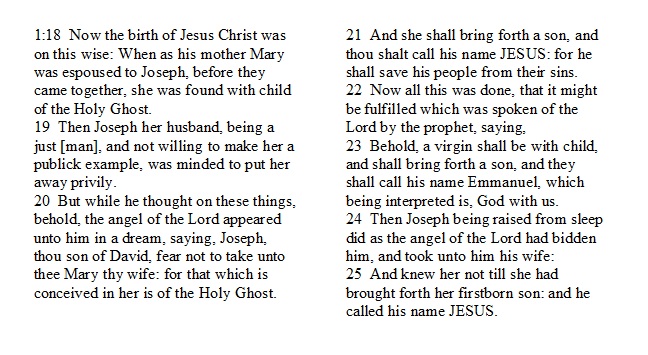
Now the birth of Jesus Christ was on this wise

Advent 2017 The Christmas Story in Matthew 1 & 2


Now the birth of Jesus Christ was on this wise - After all those begats he says, and of Jesus Christ this is how it happened. This birth looked the same as all those others but was completely different.

When as his mother Mary was espoused to Joseph, before they came together, she was found with child of the Holy Ghost - They were espoused, that is, betrothed or engaged, but they were not together. They weren’t living together and they had not been intimate, yet BAM! Mary is pregnant! Women get pregnant all the time and thus far she is no different than any other woman in the history of the world. But here is where her case is different than any other woman ever – she was found to have conceived from the Holy Spirit (YLT). Mary knew what was going on, but no one else did. “Mary, are you with child?” Yes. “Who??” “Momma, you don’t understand ... the angel Gabriel ... the Holy Spirit ... Messiah ...” Yeah, you can imagine the responses.

Then Joseph her husband, being a just man, and not willing to make her a publick example, was minded to put her away privily. - Joseph. What a pickle. He’s a righteous man. He didn’t do anything and his betrothed is with child. His plan is to put her away, that is, divorce her because a betrothal could only be ended by divorce.
He was just, or righteous. So often in our view a righteous man is only concerned with doing the right thing and looking good no matter who gets hurt, but in Scripture a righteous man is also a merciful man. So he plans to put her away secretly to reduce as much as possible the shame. Why put her away at all? He is a righteous man, he wants a righteous wife, and it sure looks like Mary has fallen short.
How did Joseph find out? We are not told. It’s possible that one day, while they were taking a walk together one evening, she told him, “Joseph, I’m with child by the power of the Holy Spirit” and he just flat out refused to believe her. While it could have happened that way, that would be rather hurtful. I tend to think they had minimal contact during this time and he was ‘informed’ of her pregnancy.

But while he thought on these things, behold, the angel of the Lord appeared unto him in a dream, saying, Joseph, thou son of David, fear not to take unto thee Mary thy wife: for that which is conceived in her is of the Holy Ghost. And she shall bring forth a son, and thou shalt call his name JESUS: for he shall save his people from their sins. - Well, well, Joseph has an angelic visitor too! The angel tells Joseph four (4) things:

fear not to take unto thee Mary thy wife
Behold how the Lord pleads our case! What a spot Mary is in! While she is no doubt elated to be the mother of Messiah, she didn’t ask for it, and she is already paying a heavy price for this blessing from God. As she trusted God for the conception, she trusted Him with the consequences, and He takes up her cause. Amen! He sends an angel to Joseph to inform him, Joseph, the righteous thing is for you to marry the girl.

for that which is conceived in her is of the Holy Ghost
What a miracle is here described in few words. “Then began our deliverance. The mystery of the humanity of Christ, that he sunk himself into our flesh, is beyond all human understanding.” (Martin Luther)

she shall bring forth a son

thou shalt call his name JESUS
The Greek is Ιησους, pronounced Yay-SOOS. In English it was originally Jesu, pronounced YAY-soo. What? Neither Hebrew, Greek, nor Latin had a ‘j’; neither did English until 1630. In fact, the 1611 King James Version has this verse, “and thou shalt call his Name Iesus.” But with the creation of the ‘j’ it is now Jesus.

The angel then explains why he was to be called Jesus – for he shall save his people from their sins. His name in Hebrew is Yeshua which means “salvation.” It is a shortened form of Yehoshua (Joshua) which means, “Yahweh saves.” Call his name salvation because that is what he will do – save his people.” He is the Savior!

see: he shall save his people from their sins

Now all this was done, that it might be fulfilled which was spoken of the Lord by the prophet, saying, Behold, a virgin shall be with child, and shall bring forth a son, and they shall call his name Emmanuel, which being interpreted is, God with us. - The prophet is Isaiah. He was prophesying to Ahab when he said, Therefore the Lord himself shall give you a sign; behold, a virgin shall conceive in the womb, and shall bring forth a son, and thou shalt call his name Emmanuel. (LXX) Conceived by a virgin. A pretty good sign for the birth of Messiah!

a virgin shall be with child – This is important. Important? Absolutely vital! Matthew sets forth the truth but doesn’t explain it. It is enough for him that this is a sign of the Messiah.

they shall call his name Emmanuel, which being interpreted is, God with us – Well, maybe Matthew does explain. Actually, Isaiah does, Matthew simply quotes him. Just who is this child?? He is Emmanuel, which means ‘God with us.’


This is the Son of God assuming flesh and entering the virgin’s womb! This is big, brothers and sisters, really big!

Then Joseph being raised from sleep did as the angel of the Lord had bidden him, and took unto him his wife: And knew her not till she had brought forth her firstborn son: and he called his name JESUS. - What faith is required! This demonstrates two aspects of faith: Mary has faith to receive a powerful work of God - there was nothing for her to do and everything for her to receive; Joseph had faith to obey. The faith of Mary and Joseph is amazing.

Joseph...did as the angel of the Lord had bidden him - He believed and obeyed (took unto him his wife) and restrained himself (And knew her not till she had brought forth her firstborn son). When you believe you obey - obedience springs from faith. Faith and obedience are like Siamese twins – you never see one without the other.

Trust and obey
for there’s no other way
to be happy in Jesus
but to trust and obey

What an amazing story Matthew is telling us. Are we supposed to believe this? Is this literal? Yes! He is telling us that Jesus is the Christ and that Christ is the Son of God!

“And we should joy and delight in these blessed things, more than in all the treasure on earth, disputing not how it came to pass, that he, who fills heaven and earth, and whom neither heaven nor earth is able to comprehend, was enclosed in the pure body of his mother. Such disputations impede our joys, and give us occasion to doubt.”  (Martin Luther)


Et homo factus est; et verbum caro factum est

(He became man; And the Word was made flesh)


<>< <>< <>< <>< <>< <>< <><
Martin Luther - Catholic monk who ignited the Protestant Reformation (1483-1546)
LXX – Septuagint; Greek translation of the Old Testament
YLT – Young’s Literal Translation

Introduction The Christmas Story in Matthew 1 & 2
First Week of Advent: The book of the generation of Jesus Christ

Friday, December 8, 2017

Know ye not?

I recently began reading 1 Corinthians. I confess, I will read a couple of days, then forget a couple of days, then read again. So, while at the rate of one chapter a day I should be finished, I read chapter 6 yesterday. It must have been a while since I last read 1 Corinthians because it seems so fresh. And when I read chapter 6 I began to notice something that I think I may have overlooked before. There is a phrase that occurs several times in this one chapter, know ye not that. I also noticed a very similar expression in v 2, do ye not know that.

I was intrigued. First, I opened my Greek New Testament. Bingo! The recurring phrase is ουκ οιδατε οτι and it occurs 6 times in this one chapter! Even in verse 2, where we have Do ye not know that, it is exactly the same as the other five know ye not that. Second, I looked up the word οιδατε (know) and discovered that this phrase only occurs 12 times in the New Testament - 6 times in this chapter; 4 other times in this letter (3:16, 5:6, 9:13, 9:24); then only twice elsewhere (Romans 6:16 & James 4:4). So, almost exclusively in Paul and in this letter to the Corinthians. Interesting.

He seems to use it as a reminder of what they are supposed to know, and maybe a gentle rebuke. 

It’s neat to look at what Paul assumed they knew (shows the depth of his teaching). Here are the verses with only the know ye not that part:

6:2 Do ye not know that the saints shall judge the world?

6:3 Know ye not that we shall judge angels?

6:9 Know ye not that the unrighteous shall not inherit the kingdom of God? 

6:15 Know ye not that your bodies are the members of Christ?

6:16 What? know ye not that he which is joined to an harlot is one body?

6:19 What? know ye not that your body is the temple of the Holy Ghost?


Everything inside me wants to go through these verses and bring out the meaning of each statement, but I think for now it’s enough for me to ask myself:

● Do I know these things?

● Do I understand their implications for and applications to my life?


Now I will grow very bold and ask you:

● Do you know these things?

● Do you understand their implications for and applications to your life?


It would appear that we ought to.


know ye not?

Wednesday, December 6, 2017

Christ or Messiah?

Advent 2017 The Christmas Story from Matthew 1-2

For my first post, The book of the generation of Jesus Christ, go here
For the introduction to this series, go here


A survey of Matthew 1 & 2 reveals that he is called many names, Jesus Christ, Jesus, Emmanuel, King of the Jews, the Christ, Governor, and Nazarene. The same survey shows that he is referred to as Christ five times. Clearly, the gospel message is that this Jesus is the Christ.

This is the message that I increasingly feel compelled to announce while at the same time being aware that the Christ says absolutely nothing to the people around me. This may also be true for many in the church. So, what does this mean, Jesus is the Christ?

Christ is a transliteration of the Greek word, christos, and according to Thayer’s Lexicon it means, anointed. Christos occurs many times in the Septuagint and is usually translated anointed; but six times it is translated Christ, three of them very significant:

Psalm 2:2 The kings of the earth stood up, and the rulers gathered themselves together, against the Lord, and against his Christ;

Daniel 9:25   And thou shalt know and understand, that from the going forth of the command for the answer and for the building of Jerusalem until Christ the prince...

Amos 4:13 For, behold, I am he that strengthens the thunder, and creates the wind, and proclaims to men his Christ...

In the 3rd century BC Jewish scholars translated the Hebrew Old Testament into Greek. Christos is the Greek translation of the Hebrew word mashiach, which means anointed or anointed one. In English it is Messiah. Messiah occurs twice in the KJV translation of the Hebrew Old Testament:

Daniel 9:25 Know therefore and understand, that from the going forth of the commandment to restore and to build Jerusalem unto the Messiah the Prince shall be seven weeks, and threescore and two weeks: the street shall be built again, and the wall, even in troublous times.
26 And after threescore and two weeks shall Messiah be cut off, but not for himself: and the people of the prince that shall come shall destroy the city and the sanctuary; and the end thereof shall be with a flood, and unto the end of the war desolations are determined. 

So which is right, Messiah or Christ? They mean the same thing, The Anointed One. We can see this from the two occurrences of Messiah (Messias in the KJV) in the New Testament:

John 1:41 He first findeth his own brother Simon, and saith unto him, We have found the Messias, which is, being interpreted, the Christ.

John 4:25 The woman saith unto him, I know that Messias cometh, which is called Christ: when he is come, he will tell us all things.

What is the Messiah?
“Messiah is the designation given by the Hebrews to that Savior and Deliverer whom they expected, and who was promised to them by all the prophets. As the holy unction was given to kings, priests, and prophets, by describing the promised Savior of the world under the name of Christ, Anointed, or Messiah, it was sufficiently evidenced that the qualities of king, prophet, and high priest would eminently center in him, and that he should exercise them not only over the Jews but over all mankind, and particularly over those who should receive him as their Savior.”  (ATS Bible Dictionary)

“This word Messiah (Mashiach) answers to the word Christ (Christos) in the New Testament. The kings of Israel were called anointed, from the mode of their consecration. (1 Samuel 2:10,35; 12:3,5 etc). This word also refers to the expected Prince of the chosen people who was to complete God's purposes for them and to redeem them, and of whose coming the prophets of the old covenant in all time spoke. He was the Messiah, the Anointed, i.e. consecrated as the king and prophet by God's appointment.”  (Smith’s Bible Dictionary)

This promise of the Savior or Messiah runs throughout the Old Testament and tells us of his nation, tribe, family; manner and place of birth; his ministry, death, resurrection, and exaltation; his kingdom (salvation, calling of the Gentiles); and his glory. This is the gospel, Jesus whom I preach to you is the Christ.

I find this interesting: In the Gospels and Acts, the aim is identifying Jesus as the Christ; but in the epistles, written to believers, he is Lord Jesus Christ, Jesus Christ, Christ Jesus; most often simply as Christ, and very rarely as Jesus.

Christ has come, he is our Savior and Jesus is his name. We see Jesus, crowned with glory and honor.

  
The Spirit of the Lord is upon me, because he hath anointed me to preach the gospel to the poor; he hath sent me to heal the brokenhearted, to preach deliverance to the captives, and recovering of sight to the blind, to set at liberty them that are bruised, to preach the acceptable year of the Lord. 
Jesus, Luke 4:18-19

How God anointed Jesus of Nazareth with the Holy Ghost and with power: who went about 
doing good, and healing all that were oppressed of the devil; for God was with him. 
Peter, Acts 10:38 

Tuesday, December 5, 2017

The book of the generation of Jesus Christ

Advent 2017 The Christmas Story from Matthew 1-2


1st Week of Advent - The book of the generation of Jesus Christ


The gospel opens with a bang! This is no mystery, no ‘who done it?” with clues scattered along the way so you can try to come up with the answer. No, right from the first verse the answer is made plain and clear: The book of the generation of Jesus Christ, the son of David, the son of Abraham.

The book of the generation (Greek βιβλος γενεσεως) is a phrase found in the LXX

Genesis 2:4 This is the book of the generation of heaven and earth, when they were made, in the day in which the Lord God made the heaven and the earth,

Genesis 5:1 This is the book of the generation of men in the day in which God made Adam

“I suppose these words to have been the original title to this Gospel; and that they signify, according to the Hebrew Phraseology, not only the account of the genealogy of Christ, as detailed below, but the history of his birth, acts, sufferings, death, resurrection, and ascension.”  (Adam Clarke)

“This book is an account, not of the divine, but human generation of Christ; and not merely of his birth; nor of his genealogy, which is contained in this chapter; but also of his whole life and actions, of what was said, done, and suffered by him. It is an Hebrew way of speaking, much like that in Genesis 5:1; and as that was the book of the generation of the first Adam; this is the book of the generation of the second Adam.”  (John Gill)

John Chrysostom begins his second homily on Matthew by voicing the supposed objection of the congregation, “ ‘Did you not promise to discourse of the Only-begotten Son of God, and do you make mention of David, and say that he is both father and ancestor?’ Stay, seek not to learn all at once, but gently and little by little. Why, it is in the vestibule that you are standing, by the very porch; why then do you hasten towards the inner shrine? [For I do not] declare unto you that other generation, for it is unutterable, and unspeakable. And before me the Prophet Esaias has told you this, saying thus, ‘Who shall declare His generation?’
It is not then of that we are now to speak, but of this beneath, this which took place on earth. Think not, therefore, it is of small things you are hearing, when you hear of this birth, but rouse up your mind, and straightway tremble, being told that God has come upon earth. For so marvellous was this, and beyond expectation, that because of these things the very angels formed a choir, and in behalf of the world offered up their praise for them, and the prophets from the first were amazed at this, that ‘He was seen upon earth, and conversed with men’. Yea, for it is far beyond all thought to hear that God the Unspeakable, the Unutterable, the Incomprehensible, and He that is equal to the Father, has passed through a virgin's womb, and has vouchsafed to be born of a woman, and to have Abraham and David for forefathers.
Hearing these things, arise, and surmise nothing low: but even because of this very thing most of all should you marvel, that being Son of the Unoriginate God, and His true Son, He suffered Himself to be called also Son of David, that He might make you son of God.
Do you see at once of what nature are the Gospels? For it is far more difficult, judging by human reason, for God to become man, than for a man to be declared a son of God. When therefore you are told that the Son of God is Son of David and of Abraham, doubt not any more that thou too, the son of Adam, shall be son of God. For not at random, nor in vain did He abase Himself so greatly - He was minded to exalt us. Thus He was born after the flesh, that you might be born after the Spirit; He was born of a woman, that you might cease to be the son of a woman.”  (John Chrysostom)

1 the son of David -  "Nothing is more common in the Jewish writings, than for the son of David to stand alone for the Messiah."  (John Gill)

1 the son of Abraham - "Abraham was the first to whom a particular promise was made, that the Messiah should spring from, Genesis 22:18. The first promise in Genesis 3:15 only signified that he should be the seed of the woman; and it would have been sufficient for the fulfillment of it, if he had been born of any woman, in whatsoever nation, tribe, or family; but by the promise made to Abraham he was to descend from him."  (John Gill)

In verses 2-16 we have a whole lot of “begats”. Why? Matthew wrote his gospel for the Jews and he wanted to demonstrate that Jesus was descended from Abraham through David and was thereby qualified to be the Christ.

16 And Jacob begat Joseph the husband of Mary, of whom was born Jesus  Jesus was not Joseph’s son, so how does Joseph’s genealogy prove anything? “First, I can assure you that Mary was also of the house of David, “a virgin espoused to a man whose name was Joseph, of the house of David; and the virgin's name was Mary.” It was not the law among the Jews that the genealogy of women should be traced. In order then that he might keep the custom, and not seem to be making alterations from the beginning, and yet might make the Virgin known to us, for this cause he has passed over her ancestors in silence, and traced the genealogy of Joseph. For if he had done this with respect to the Virgin, he would have seemed to be introducing novelties; and if he had passed over Joseph in silence, we should not have known the Virgin's forefathers. In order therefore that we might learn, touching Mary, who she was, and of what origin, he has traced the genealogy of her espoused husband, and shown him to be of the house of David. For when this has been clearly proved, that other fact is demonstrated with it, namely, that the Virgin likewise is sprung from thence, by reason that this righteous man, even as I have already said, would not have endured to take a wife from another race.”  (Chrysostom)

17 So all the generations from Abraham to David are fourteen generations; and from David until the carrying away into Babylon are fourteen generations; and from the carrying away into Babylon unto Christ are fourteen generations.
What does this emphasis on fourteen generations signify? I confess, I don’t understand this, but I do understand that “His argument was merely to show that Jesus Christ as surely descended, in an uninterrupted line from David, as David did from Abraham. And this he has done in the most satisfactory manner; nor did any person in those days pretend to detect any inaccuracy in his statement "  (Adam Clarke)

Now, about some notorious women in the genealogy, namely Thamar, Rahab, Ruth, Bathsheba

“When tracing the genealogy through the men, he has mentioned women also; and why since he determined upon doing this, he yet did not mention them all, but passing over the more eminent, such as Sarah, Rebecca, and as many as are like them, he has brought forward only them that are famed for some bad thing. For he has made mention of the wife of Uriah, and of Thamar, and of Rahab, and of Ruth, of whom one was of a strange race [Ruth], another an harlot [Rahab], another was defiled by her near kinsman, and with him not in the form of marriage, but by a stolen intercourse, when she had put on herself the mask of an harlot [Thamar]; and touching the wife of Uriah [Bathsheba] no one is ignorant, by reason of the notoriety of the crime. And yet the evangelist has passed by all the rest, and inserted in the genealogy these alone . . . [by this] His glory is manifested; not by having great forefathers, but low and of little account. For to the lofty One it is a great glory to be able to abase Himself exceedingly.”  (Chrysostom)

And finally,
16  And Jacob begat Joseph the husband of Mary, of whom was born Jesus, who is called Christ.

When he says, who is called, he is saying he is known as Christ, that this is his name.

I think the highlighted part would be better translated, the one who is called the Christ or simply, the one called the Christ. There are many times in the Scripture where Jesus is called the Christ, but our translation omits the article, as a result I believe we miss the emphasis. Christ is not his last name, it is a title, Jesus the Christ.

So right from the beginning, plainly and emphatically, Matthew tells us that Jesus of Nazareth is the Christ. This is good news indeed: the promised Deliverer has come; the long awaited Savior has appeared; God’s promise of the Christ has been fulfilled!


See Part 2 Christ or Messiah?


<>< <>< <>< <>< <>< <>< <><
Adam Clarke – English Methodist theologian and biblical scholar; 1760-1832
John Gill - English Baptist pastor, biblical scholar, and theologian; 1697-1771
John Chrysostom - Archbishop of Constantinople; 349–407
LXX – Septuagint; Greek translation of the Old Testament

Tuesday, November 28, 2017

Advent 2017 The Christmas Story from Matthew


When we think of the Christmas story we usually see it through the eyes of Luke – the angel visiting Mary, the manger, the angelic choir, the shepherds; the visit to Jerusalem when he was 8 days old and the encounters with Anne and Simeon. Such richness in those first two chapters!

This year I thought I would look at how Matthew presents the birth of Christ. We are not totally unfamiliar with him, but the rhythms of his story are different. And the story he relates is an amazing one!

The Lord willing I will take a look at the first two chapters of Matthew, offering one post each week of Advent. What is Advent? It is the first season of the Christian church year, the four Sundays leading up to Christmas Day.

Ah, the church year. Unless you are part of a liturgical church, this can be somewhat mysterious. The church year follows the life of Christ and is a way for the church to keep the focus on Christ.


I confess, while I know the big picture, I’m not so good on all the details.

Now, back to Advent. It is a season observed as a time of expectant waiting and preparation for the celebration of the Nativity of Jesus at Christmas. Advent comes from the Latin word adventus, meaning coming and offers the opportunity to share in the ancient longing for the coming of the Messiah, and to be alert for his Second Coming.

As I said, I want to take a look at how Matthew presents the Christmas story and since I am really creative I am calling it, The Christmas Story from MatthewThis year Advent is December 3rd through December 24th. Here is my plan:

December 3 1st Week of Advent 
1:1-17  The book of the generation of Jesus Christ

December 10 2nd Week of Advent
1:18-25  Now the birth of Jesus Christ was on this wise

December 17 3rd Week of Advent 
2:1-11 There came wise men from the east

December 24 4th Week of Advent
2:12-23 Out of Egypt have I called my son

My posts will be a little bit longer than usual. I plan to post once a week, Tuesday, to be precise, but I have discovered that I will need an additional post each week lest my posts turn into short books! Here are my planned second posts

1st Week  Messiah or Christ?
2nd Week He shall save his people from their sins
3rd Week  We have seen his star in the east
4th Week  Dreams & Visions

I hope you will follow along through the season and I pray the Lord will bless you and strengthen you in the grace and faith of our Lord Jesus Christ.