Thursday, March 5, 2020

The three greatest events in the history of the world Part 2

A couple of years ago when our Life Group was going through 1 John, I shared with them the three greatest events in the history of the world. I even added a future fourth event, because it is related to the first three. I got to thinking about them recently and wanted to share them again, this time in more detail. This is Part 2.

In Part 1 I offered the first two greatest events in the history of the world: the Creation of the world and the Incarnation of the Son of God. Today, the third greatest event:

3. Resurrection of Jesus from the dead

We have seen that God created the world ex nihilo, out of nothing; then He formed man from the dust of the ground and woman from the rib of the man. Man was created for fellowship with God but fell into sin and corruption and death; and to rescue His creation from sin and corruption God promised a Savior. This Savior is His own Son, who himself created the world and man in his image. In fulfillment of the promise, the Son of God was incarnate, made flesh, being conceived by the Holy Spirit and born of the Virgin Mary; he became man that he might give himself as a sacrifice for the undone race. He was crucified, died, and was buried, but on the third day he rose again from the dead! This is clearly one of the greatest events in the history of the world!!

Every Gospel tells us of the ministry of Jesus, ending with his crucifixion and resurrection. Here is the account of the resurrection in the Gospel According to Luke. I’ve highlighted the significant parts:

Luke 24
1 Now upon the first day of the week, very early in the morning, they came unto the sepulchre, bringing the spices which they had prepared, and certain others with them.  
2 And they found the stone rolled away from the sepulchre.  
3 And they entered in, and found not the body of the Lord Jesus.  
4 And it came to pass, as they were much perplexed thereabout, behold, two men stood by them in shining garments:  
5 And as they were afraid, and bowed down their faces to the earth, they said unto them, Why seek ye the living among the dead?  
6 He is not here, but is risen: remember how he spake unto you when he was yet in Galilee, 

After this Peter runs to the tomb and finds it empty (11-12).
Jesus appears to two men walking to Emmaus who tell him the women found not his body (13-35).
Jesus appears to all the disciples (38-49)

37 But they were terrified and affrighted, and supposed that they had seen a spirit. 
38 And he said unto them, Why are ye troubled? and why do thoughts arise in your hearts? 
39 Behold my hands and my feet, that it is I myself: handle me, and see; for a spirit hath not flesh and bones, as ye see me have.  
40 And when he had thus spoken, he shewed them his hands and his feet.
41 And while they yet believed not for joy, and wondered, he said unto them, Have ye here any meat?  
42 And they gave him a piece of a broiled fish, and of an honeycomb.  
43 And he took it, and did eat before them.  

Luke could not be clearer or more emphatic: Jesus was raised from the dead. His body. His flesh. Jesus was made flesh (incarnation), suffered and died on the cross, was buried, and this body was raised again. He doesn’t merely live on in our memory, or as a spirit, NO! he was raised from the dead! As Jesus himself said, I am the one who lives, and was dead, and, behold, I am alive for evermore, Amen.

Ignatius (AD 35-108), a disciple of the Apostle John, bishop of Antioch, and martyr said, “He suffered truly, even as also He truly raised up Himself. For I know that after His resurrection also He was still possessed of flesh, and I believe that He is so now.”

I’m seeing a pattern here. At Creation, man was formed of the dust of the ground; woman was formed from one of his ribs; the essential nature of man is body and soul. At the Incarnation, the Son of God was made flesh. At the Resurrection, the very body of Jesus was raised up!


Why do I not list the cross as one of the three greatest events in the history of the world? It was indeed a great event; one that secures our salvation and restoration to God, and demonstrated God’s great love for us, but in a sense it is a dependent event. What? Yes. The Incarnation gives the cross value – it was the Son of God who was crucified. The Resurrection gives it power – he died to free us from sin and death; the resurrection demonstrates he won!

"At the cross Jesus cried, It is finished! Through the resurrection the Father cried, Amen!” ~ Terry Virgo


As I said at the beginning, there is a fourth event, a future event, that will change the world

4. Second Coming of Jesus

Acts 1:9-11
  9 And when he had spoken these things, while they beheld, he was taken up; and a cloud received him out of their sight.  
10 And while they looked stedfastly toward heaven as he went up, behold, two men stood by them in white apparel;  
11 Which also said, Ye men of Galilee, why stand ye gazing up into heaven? this same Jesus, which is taken up from you into heaven, shall so come in like manner as ye have seen him go into heaven.

This same Jesus. He was made flesh, suffered and died in the flesh, rose in the flesh, and is coming again in the flesh.

His first coming was humble and lowly, his second coming will be with power and glory. He will appear in the sky and every eye will see him as he descends to the earth; his feet will touch the Mount of Olives; the dead will be raised; there will be the judgment; he will establish his kingdom on the earth; there will be a new heaven and a new earth. “Oh what a day that will be, when my Jesus I shall see!”

And speaking of the resurrection of the dead, he will raise our bodies from the grave. The pattern will come full circle: made flesh at the beginning, the Word made flesh, his flesh raised from the dead, our flesh raised from the dead. As I wrote last year, redemption is physical!

And the seventh angel sounded; and there were great voices in heaven, saying, The kingdoms of this world are become the kingdoms of our Lord, and of his Christ; and he shall reign for ever and ever.


Surely I come quickly. Amen. Even so, come, Lord Jesus.

Wednesday, March 4, 2020

The three greatest events in the history of the world

A couple of years ago, when our Life Group was going through 1 John, I shared with them the three greatest events in the history of the world. I even added a future fourth event, because it is related to the first three. I got to thinking about them recently and wanted to share them again, this time in more detail. This is Part 1.

1. Creatio ex nihilo

Naturally, the creation of the world itself would be first on the list! In the beginning God created the heaven and the earth. Creatio ex nihilo is Latin for creation from nothing, which means God created the world, not from pre-existing material, but from nothing. There was nothing. He spoke. And there was something.

Hebrews 11:3 the worlds were framed by the word of God, so that things which are seen were not made of things which do appear. 

It is really amazing to read through Genesis 1 and see the pattern: And God said…and it was so. There was nothing. He spoke. And there was something. Oh the power! Oh the wisdom! Oh the glory that belongs to the Creator!

Furthermore He created all things by His Son:

Colossians 1:12-17 For by him [the Son] were all things created, that are in heaven, and that are in earth, visible and invisible, whether they be thrones, or dominions, or principalities, or powers: all things were created by him, and for him: And he is before all things, and by him all things consist. 

Thou art worthy, O Lord, to receive glory and honour and power:
for thou hast created all things,
and for thy pleasure they are and were created.

Then we have the crowning point of creation:

Genesis 1:27 So God created man in his own image, in the image of God created he him; male and female created he them.

Genesis 2:7; 21-22 And the LORD God formed man of the dust of the ground, and breathed into his nostrils the breath of life; and man became a living soul. And the LORD God caused a deep sleep to fall upon Adam, and he slept: and he took one of his ribs, and closed up the flesh instead thereof; And the rib, which the LORD God had taken from man, made he a woman, and brought her unto the man.

Man was not spoken into existence, but was formed of the dust of the ground; and the woman was made from one of Adam’s ribs. See how this unites us to the earth and to one another!

Genesis 1:31 And God saw every thing that he had made, and, behold, it was very good.

What a beginning! What a wonderful world He handed to Adam and Eve! But they sinned, and when they sinned there was a drastic change. What was very good was now corrupted and subject to death. Therefore God promised a Savior, a Deliverer, who would redeem and restore mankind and creation to Himself. The rest of the Old Testament is the story of God preparing the way and setting the stage for the Redeemer to come.

Which brings us to the second greatest event in the history of the world

2. Incarnatione De Verbi Dei

Athanasius (296-373), a bishop and theologian, wrote a great little book, De Incarnatione De Verbi Dei.* Latin makes it sound impressive, doesn’t it? Well, it is! In English the title is, The Incarnation of the Word of God.

The Word of God is the Son of God. This is the Redeemer promised throughout the Old Testament! The Incarnation was when the Son of God was made flesh. He was made man that he might redeem us from sin and death. This indeed was a momentous event in the history of the world!

John 1:14 And the Word was made flesh, and dwelt among us

How did this happen?

Luke 1:26-35 And in the sixth month the angel Gabriel was sent from God unto a city of Galilee, named Nazareth, To a virgin espoused to a man whose name was Joseph, of the house of David; and the virgin's name was Mary.
And the angel came in unto her, and said, Hail, thou that art highly favoured, the Lord is with thee: blessed art thou among women. And when she saw him, she was troubled at his saying, and cast in her mind what manner of salutation this should be. And the angel said unto her, Fear not, Mary: for thou hast found favour with God. And, behold, thou shalt conceive in thy womb, and bring forth a son, and shalt call his name JESUS. He shall be great, and shall be called the Son of the Highest: and the Lord God shall give unto him the throne of his father David: And he shall reign over the house of Jacob for ever; and of his kingdom there shall be no end.
Then said Mary unto the angel, How shall this be, seeing I know not a man?
And the angel answered and said unto her, The Holy Spirit shall come upon thee, and the power of the Highest shall overshadow thee: therefore also that holy thing which shall be born of thee shall be called the Son of God.

What are we talking about here? The Son of God, the Creator of all things visible and invisible, was made flesh. He became a man. He was really hungry and tired, He really bled when pierced with a spear and nailed to the cross, he really died and was buried.

As Athanasius explained it in his book:

“But He comes in condescension to show loving-kindness upon us, and to visit us. And seeing the race of rational creatures in the way to perish, and death reigning over them by corruption; seeing, once more, the unseemliness of what had come to pass: that the things whereof He Himself was Artificer were passing away: seeing, further, the exceeding wickedness of men, and how little by little they had increased it to an intolerable pitch against themselves: and seeing, lastly, how all men were under penalty of death: He took pity on our race, and had mercy on our infirmity, and condescended to our corruption, and, unable to bear that death should have the mastery — lest the creature should perish, and His Father's handiwork in men be spent for nought — He takes unto Himself a body, and that of no different sort from ours. He takes a body of our kind, and not merely so, but from a spotless and stainless virgin, knowing not a man, a body clean and in very truth pure from intercourse of men. For being Himself mighty, and Artificer of everything, He prepares the body in the Virgin as a temple unto Himself, and makes it His very own as an instrument, in it manifested, and in it dwelling. And thus taking from our bodies one of like nature, because all were under penalty of the corruption of death He gave it over to death in the stead of all, and offered it to the Father.”

Amen! The Incarnation leads to the cross. The work of salvation begins with the Incarnation, with the Word being made flesh. The Son of God became a man that he might restore us to God through his death on the cross.

The greatest event in the history of the world since creation!


* Athansaius originally wrote this book in Greek and in Greek the title is,
Λογος Περι Της Ενανθρωπησεως Του Λογου Και Της Δια Σωματος Προς Ημας Επιφανεις Αυτου
I don’t know why that never caught on! My rough translation into English would be, A Word Concerning The Word Becoming Man And His Manifestation To Us Through His Body. I like this much better!


Tomorrow: The Three Greatest Events In The History Of The World Part 2

Monday, March 2, 2020

The Rule of Faith

Last week I wrote on Apostolic Tradition, you can read it here. I concluded with three related questions, So what is this Apostolic Tradition? What is it that the Apostles handed down orally? What was it they deposited in the Church?

Simply stated: They handed down The Faith. The early Church called it The Rule of Faith. The word rule (Latin regula, Gr. kanon) means a standard by which something can be tested, and the Rule of Faith (Latin: regula fidei) serves as the norm or measure of the faith, the authority or standard for the faith. What early believers called the Rule of Faith was later called the Creed.

Irenaeus (AD 130-202)+ explains the role of Apostolic Tradition and the Rule of Faith for the early church:

Demonstration of Apostolic Preaching
“3. Now, that we may not suffer ought of this kind [heresy], we must needs hold the rule of the faith without deviation, and do the commandments ...  Now this doing is produced by faith … And faith is produced by the truth ; for faith rests on things that truly are … Now faith occasions this for us; even as the Elders, the disciples of the Apostles, have handed down to us.”

The rest of this excellent book is devoted to expounding the faith that has been handed down from the Apostles. I highly recommend it.

Against Heresies Book I
Chapter 10
1. The Church, though dispersed throughout the whole world, even to the ends of the earth, has received from the apostles and their disciples this faith: [She believes] in one God, the Father Almighty, Maker of heaven, and earth, and the sea, and all things that are in them; and in one Christ Jesus, the Son of God, who became incarnate for our salvation; and in the Holy Spirit, who proclaimed through the prophets the dispensations of God, and the advents, and the birth from a virgin, and the passion, and the resurrection from the dead, and the ascension into heaven in the flesh of the beloved Christ Jesus, our Lord, and His [future] manifestation from heaven in the glory of the Father to gather all things in one, and to raise up anew all flesh of the whole human race, in order that to Christ Jesus, our Lord, and God, and Saviour, and King, according to the will of the invisible Father, every knee should bow, of things in heaven, and things in earth, and things under the earth, and that every tongue should confess to Him, and that He should execute just judgment towards all; that He may send spiritual wickednesses, and the angels who transgressed and became apostates, together with the ungodly, and unrighteous, and wicked, and profane among men, into everlasting fire; but may, in the exercise of His grace, confer immortality on the righteous, and holy, and those who have kept His commandments, and have persevered in His love, some from the beginning [of their Christian course], and others from [the date of] their repentance, and may surround them with everlasting glory.

2. As I have already observed, the Church, having received this preaching and this faith, although scattered throughout the whole world, yet, as if occupying but one house, carefully preserves it. She also believes these points [of doctrine] just as if she had but one soul, and one and the same heart, and she proclaims them, and teaches them, and hands them down, with perfect harmony, as if she possessed only one mouth. For, although the languages of the world are dissimilar, yet the import of the tradition is one and the same. For the Churches which have been planted in Germany do not believe or hand down anything different, nor do those in Spain, nor those in Gaul, nor those in the East, nor those in Egypt, nor those in Libya, nor those which have been established in the central regions of the world. But as the sun, that creature of God, is one and the same throughout the whole world, so also the preaching of the truth shines everywhere, and enlightens all men that are willing to come to a knowledge of the truth. Nor will any one of the rulers in the Churches, however highly gifted he may be in point of eloquence, teach doctrines different from these (for no one is greater than the Master); nor, on the other hand, will he who is deficient in power of expression inflict injury on the tradition. For the faith being ever one and the same, neither does one who is able at great length to discourse regarding it, make any addition to it, nor does one, who can say but little diminish it.

Against Heresies Book III
Chapter 1
1. We have learned from none others the plan of our salvation, than from those through whom the Gospel has come down to us, which they did at one time proclaim in public, and, at a later period, by the will of God, handed down to us in the Scriptures, to be the ground and pillar of our faith.

Chapter 2
2. But, again, when we refer them to that tradition which originates from the apostles, [and] which is preserved by means of the succession of presbyters in the Churches, they object to tradition…

Chapter 4
1. Since therefore we have such proofs, it is not necessary to seek the truth among others which it is easy to obtain from the Church; since the apostles, like a rich man [depositing his money] in a bank, lodged in her hands most copiously all things pertaining to the truth: so that every man, whosoever will, can draw from her the water of life. For she is the entrance to life; all others are thieves and robbers. On this account are we bound to avoid them, but to make choice of the thing pertaining to the Church with the utmost diligence, and to lay hold of the tradition of the truth. For how stands the case? Suppose there arise a dispute relative to some important question among us, should we not have recourse to the most ancient Churches with which the apostles held constant intercourse, and learn from them what is certain and clear in regard to the present question? For how should it be if the apostles themselves had not left us writings? Would it not be necessary, [in that case,] to follow the course of the tradition which they handed down to those to whom they did commit the Churches?

2. To which course many nations of those barbarians who believe in Christ do assent, having salvation written in their hearts by the Spirit, without paper or ink, and, carefully preserving the ancient tradition, believing in one God, the Creator of heaven and earth, and all things therein, by means of Christ Jesus, the Son of God; who, because of His surpassing love towards His creation, condescended to be born of the virgin, He Himself uniting man through Himself to God, and having suffered under Pontius Pilate, and rising again, and having been received up in splendour, shall come in glory, the Saviour of those who are saved, and the Judge of those who are judged, and sending into eternal fire those who transform the truth, and despise His Father and His advent. Those who, in the absence of written documents, have believed this faith, are barbarians, so far as regards our language; but as regards doctrine, manner, and tenor of life, they are, because of faith, very wise indeed; and they do please God, ordering their conversation in all righteousness, chastity, and wisdom.


Irenaeus is very clear: “the apostles, like a rich man [depositing his money] in a bank, lodged in her hands most copiously all things pertaining to the truth.” They gave the Church their writings, the Scriptures, but they also handed down The Faith, what they called in Irenaeus’ day, The Rule of Faith. This is the Apostolic Tradition. This is what the Apostles handed down orally. This is very important. Later I plan to explain the relationship of the Rule of Faith to the Scriptures and to statements of faith today.

Next Monday: Origen


+ Irenaeus was the bishop of Lugdunum (now Lyon in the south of France). He had seen and heard the preaching of Polycarp, who was a disciple of the Apostle John. His best-known work is Against Heresies, or On the Detection and Overthrow of the So-Called Gnosis (Ancient Greek : Ἔλεγχος καὶ ἀνατροπὴ τῆς ψευδωνύμου γνώσεως), sometimes referred to by its Latin title Adversus Haereses. It was written in AD 180.

Wednesday, February 26, 2020

Jonah


The book of Jonah. What is it all about? Is it simply the story of a man who was swallowed by a whale? And, is it saying Jonah was literally swallowed by a whale?

A few weeks ago I turned on the radio and caught the tail end of a man preaching through the book of Jonah. He said the book was about idols in our hearts. Really? I didn’t hear him again so I don’t know how he explained that, but it did get me to thinking. Naturally, I wanted to share my thoughts here.

First, I accept Jonah at face value. I believe there was really a man named Jonah, although his name was really Yonah (there is no ‘J’ in Hebrew). He was a prophet who is also mentioned in 2 Kings 14:25. I believe this is a book about a real man and that the events described in the book happened just as it says.

With that out of the way, what is the point of the book? There is a point or purpose for the book, even though there are other wonderful and powerful truths contained in it. I want to consider these truths first, then explain the purpose of the book.

The Name
1:1  Now the word of the LORD came unto Jonah the son of Amittai, saying,
When LORD is in the upper case or all caps, it is the personal name of God: YHWH, which many pronounce Yahweh.+  It is interesting to follow along and see when YHWH is used and by whom.

Chapter 1 is the account of Jonah’s call and his attempt to flee.
- In verses 1-4 he is called and commissioned by Yahweh to go to Nineveh. Instead, he gets on a ship seeking to flee from the presence of Yahweh, Who then sent out a great wind and caused a storm that threatened the ship.
- In 5-7 his shipmates call upon their various gods for help; god(s) is Elohim, not YHWH.
- In 8-16 Jonah explains who he is, why he is on board, what God he serves, and how they can stop the storm. In this passage we find the shipmates calling on Yahweh for help and safety, and when throwing Jonah out of the ship results in calm seas, they feared Yahweh with a great fear and offered sacrifice to Him.

It is YHWH again in Jonah’s prayer in ch 2. Then when he is in Nineveh (ch 3), the Ninevites refer to Him as Elohim (God). Then it is back to YHWH in ch 4.

In other words, he is YHWH (Yahweh) only to His covenant people.

The God who pursues
3  But Jonah rose up to flee unto Tarshish from the presence of the LORD, and went down to Joppa; and he found a ship going to Tarshish: so he paid the fare thereof, and went down into it, to go with them unto Tarshish from the presence of the LORD.
Jonah is called and sent to Nineveh but he does the exact opposite and heads to Tarshish! Why? This will be explained a little later when we get to the purpose of the book. Be that as it may, God doesn’t let him go, and this is a powerful truth: You can run, but you cannot hide! Jonah ran, but God came after him. There is great comfort in this, even though the storm and the belly of the fish was not pleasant. The comfort is this: God wants to restore us to Himself when we fall into sin, and He will pursue us.

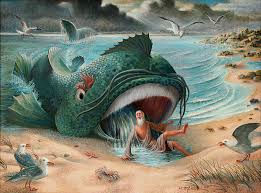
The whale
1:17  Now the LORD had prepared a great fish to swallow up Jonah. And Jonah was in the belly of the fish three days and three nights.
This of course is what everyone thinks of when they hear about Jonah, as if this was the theme and purpose of the book. I tell you, it is not. Obviously, this is a great miracle, but the book does not dwell on it.
Was this a whale or what? Well, the Hebrew says fish. English translations of the Hebrew say fish. The Tanakh (Jewish translation) says fish. The Peshitta (the Authorized Bible of the Church of the East; Syrian), says fish. The Latin says fish (piscem). The Septuagint (LXX; Greek Old Testament) says whale. Aha! This is the word κήτει (ketei), and since the majority of allusions, references, and quotations from the Old Testament in the New Testament are from the LXX, the New Testament uses the word ketei (I believe cetacea comes from this word). But this Greek word means sea-monster, whale, huge fish. It could have been a whale, since they are huge, but the text just means a really big fish.

On being restored
Chapter 2 The beautiful prayer of Jonah in the belly of said fish. What do you do when you’ve run away from God or fallen into sin and want to come home? You pray. I cried in my affliction to the Lord my God. Amen. Salvation is of the LORD. Amen, again!

On the road again
Chapter 3 Jonah is restored to God and the fish spits him out. What now? As much as possible, you return to what you know God wants you to do. For Jonah, the word is still, Go to Nineveh. He does just that, preaches the preaching, they repent, and God spares them. They turned every one from their evil way, and from the iniquity that was in their hands. And God saw their works, that they turned from their evil way; and God repented of the evil, that he had said that he would do unto them; and he did it not. The prophet Amos cried, Prepare to meet thy God. How do we prepare? Turn to the Lord by repenting and believing in Jesus. When we do that God shows mercy to us. Hallelujah!

Temper, temper
Chapter 4 Jonah has a hissy fit because God spared them.

The Purpose of the book of Jonah
All this brings us finally to the purpose of the book. If none of the above are the purpose or theme, what is? This is captured in the first and last verses of the book:

1:1-2 Now the word of the LORD came unto Jonah the son of Amittai, saying, Arise, go to Nineveh, that great city, and cry against it; for their wickedness is come up before me.

4:10-11  Then said the LORD, Thou hast had pity on the gourd, for the which thou hast not laboured, neither madest it grow; which came up in a night, and perished in a night: And should not I spare Nineveh, that great city, wherein are more than 120,000 persons that cannot discern between their right hand and their left hand; and also much cattle?

YHWH is Lord and Savior of all people. He judges nations. He saves nations. Israel was indeed His covenant people, but He has mercy on any one and every one who will turn from their evil way and call upon Him. This is a foreshadowing of the Gospel days to come!!

So this is not Jonah: The Story Of A Man Swallowed By A Whale, but rather Jonah: The Story Of God Having Mercy On Nineveh

The sad thing is, Jonah knew this:

4:2 And he prayed unto the LORD, and said, I pray thee, O LORD, was not this my saying, when I was yet in my country? Therefore I fled before unto Tarshish: for I knew that thou art a gracious God, and merciful, slow to anger, and of great kindness, and repentest thee of the evil.
He fled because he knew that if they repented God would spare them. Oh what this says about the character of God! And what it says about Jonah - he only went to Nineveh because he wanted to see it destroyed! This is really sad. But God uses imperfect vessels. And how I thank Him for that!!


How does this book further the promise of Messiah? Jesus said Jonah in the belly of the fish was a picture of his death and resurrection. It was no accident that it was three days and nights!


Interesting side notes

The Septuagint adds what I consider a humorous detail in 1:5-6
But Jonas was gone down into the hold of the ship, and was asleep, and snored. And the shipmaster came to him, and said to him, Why snorest thou?


Jonah’s hissy fit in chapter 4. I can’t explain it. And the Bible doesn’t have to record it, because honestly he looks rather childish and petty, not prophet like at all. But that’s the Bible, it tells the stories warts and all. Another reason I believe it to be true.


Thou art a gracious God, and merciful, slow to anger and of great kindness


+ YHWH The Jews stopped pronouncing this a long time ago, as a result no one is certain how it should be pronounced. Old Bibles used Jehovah, many people today think it should be Yahweh.

Monday, February 24, 2020

Apostolic Tradition

In 1979 Ralph Neighbour wrote a book, The Seven Last Words of the Church. Interesting title. What would they be? We’ve never tried it that way before. (or as I know it, We’ve never done it that way before.) That is what often comes to mind when we start talking about tradition in the church.

Essentially, tradition is the ways things have always been done. We celebrate July 4 with hamburgers and hot dogs on the grill, and fireworks that night. Tradition. Open one present on Christmas Eve. Tradition. The church has these kind of traditions as well. I’ve heard it said, Do it twice and it’s a tradition. Tradition is comfortable. You know what’s going to happen when and how it is to be done. On the surface there’s nothing wrong with that. Sadly, traditions often become golden cows – We’ve never done it that way before and we can't do it that way. Ah, now we have a problem.

But that’s not the kind of tradition I’m talking about. I’m talking about Apostolic Tradition. “What in the world is that?” you may be thinking. It is the belief that the Apostles wrote some things down and delivered other things orally. The Bible would be the written down things, the inspired, authoritative Word of God. Apostolic Tradition would be the orally handed down things.

The Jews were a people of tradition. According to Mark 7:1-16 they had traditions that had supplanted the Word of God. But they also had tradition that ran alongside the Word of God and complimented it. The concept of Messiah can be found in the Scriptures, but it is also clearly in the tradition of the Jews. You see it in the Targums (paraphrase / interpretation of the Scripture). There are many Christians who totally dismiss the idea of authoritative Apostolic Tradition, yet these same brethren will refer to the traditional Jewish understanding of the Coming One. And I think rightly so.

The Apostles were Jews and were familiar with this idea of written Word and oral tradition going hand in hand. Is there any evidence in the Scriptures that the Apostles handed down oral instructions that were authoritative, that are not recorded in their writings? Yes, there is.

The word tradition, παράδοσις (paradosis), occurs thirteen times in the New Testament; it means “something given over by word of mouth; tradition.” Several times it refers to Jewish tradition as in the passage in Mark above. Other times it refers to something the Apostles handed over to the churches:

1 Corinthians 11:2 Now I praise you, brethren, that ye remember me in all things, and keep the ordinances [traditions], as I delivered them to you.

2 Thessalonians 2:15 Therefore, brethren, stand fast, and hold the traditions which ye have been taught, whether by word, or our epistle.

2 Thessalonians 3:6 Now we command you, brethren, in the name of our Lord Jesus Christ, that ye withdraw yourselves from every brother that walketh disorderly, and not after the tradition which he received of us.

1 Thessalonians 4:1 Furthermore then we beseech you, brethren, and exhort you by the Lord Jesus, that as ye have received of us how ye ought to walk and to please God, so ye would abound more and more. 2 For ye know what commandments we gave you by the Lord Jesus. 
[While this does not use the word tradition, it does refer to oral instruction.]

The early church Fathers verify this. I was never taught this in Bible College, but all you have to do is read the Ante-Nicene Fathers (ante is before) - they still have the voices of the Apostles ringing in their ears!! Here’s just a short list:

Clement of Rome (AD 35-99)
"The apostles have preached the gospel to us from the Lord Jesus Christ; Jesus Christ [has done so] from God. Christ therefore was sent forth by God, and the apostles by Christ…. they appointed the first fruits [of their labours]… to be bishops and deacons of those who should afterwards believe. Our apostles … afterwards gave instructions, that when these should fall asleep, other approved men should succeed them in their ministry."

Irenaeus (AD 130-202)
"The Church, though dispersed throughout the whole world, even to the ends of the earth, has received from the apostles and their disciples this faith…"

"But, again, when we refer them to that tradition which originates from the apostles, [and] which is preserved by means of the succession of presbyters in the Churches..."

"…since the apostles, like a rich man [depositing his money] in a bank, lodged in her hands most copiously all things pertaining to the truth: so that every man, whosoever will, can draw from her the water of life."

"For how should it be if the apostles themselves had not left us writings? Would it not be necessary, [in that case,] to follow the course of the tradition which they handed down to those to whom they did commit the Churches?"

Origen, of Alexandria (AD 185-254)
"Now it ought to be known that the holy apostles, in preaching the faith of Christ, delivered themselves with the utmost clearness on certain points which they believed to be necessary to every one, even to those who seemed somewhat dull in the investigation of divine knowledge... The particular points clearly delivered in the teaching of the apostles are as follow:—"

Is it surprising that the Apostles taught things they didn’t write down? Or that the Church would remember them? I wouldn’t be surprised. I still remember something Chuck Smith said at a Pastors Conference many years ago that greatly impacted me: “Always start on time – otherwise you are teaching them to be late.” And I did, too! I think of that every time a church begins the service later than the announced time….

So what is this Apostolic Tradition? What is it that the Apostles handed down orally? What was it they deposited in the Church?


Next Monday: The Rule of Faith

Tuesday, February 11, 2020

What? Me political?

I very rarely write anything about politics, but I heard something on the news today out of the New Hampshire Primary that got my attention. I Googled it and found a couple of articles on this - one on townhall.com and another on washingtonexaminer.com. I don’t know anything about either one, but they agreed in substance so… Anyway

On Sunday while in New Hampshire, Joe Biden said:

"Those who say 'the tree of liberty is watered with the blood of patriots'–  a great line. Well, guess what? The fact is if you’re going to take on the government you need an F-15 with Hellfire missiles. There is no way an AK-47 is going to take care of you if you're worried about the government knocking down your door."

Why did this get my attention? It sounds like a threat to me. Or at the very least, “Just capitulate to the government now, you can’t win.” I’m not a political animal, but I am an American (uh, England and King George), a South Carolinian (secession), and a child of the 60’s (don’t trust the Establishment). My hackles were raised. I’m pretty sure this is the very reason the Founding Fathers set forth the right of citizens to keep and bear arms in Second Amendment. 

Beckett Adams, in an opinion piece in the aforementioned Washington Examiner, wrote:

“First, what Biden said is a threat. Resistance is futile because the federal government can have you all killed at any time it wants. How inspiring. How presidential.

Further, the former vice president’s comments reveal a general ignorance of one of the most brilliant aspects of the Second Amendment. It creates a careful (albeit admittedly lopsided) balancing act between ruler and ruled. A well-armed militia will obviously be outgunned by a professional military, but that is not the point. The point is that the people can make themselves very hard to govern when the intentions of those in power are evil. When all other checks and balances fail, politicians tempted to subvert the Constitution still feel themselves limited by the friction they know they could encounter in the form of an enraged, well-armed citizenry.

It is also embarrassing to see a man who lived through the Vietnam War, the Soviets’ unsuccessful campaign in Afghanistan, and the Iraq War laugh off the idea of an armed insurrection rebuffing the world’s most advanced and best-equipped military.

Lastly, it should not be lost on anyone that Biden downplayed the importance and efficacy of well-armed militias by quoting Thomas Jefferson, who played a rather large role in the defeat of one of the world's greatest military forces by a ragtag army consisting of regulars and militiamen.”
(You can read the article here)


Since I am writing about political things, Democrat Presidential hopeful Tulsi Gabbard (Hawai’i) sent me an email today saying she would like to call me this week (well, the South Carolina Primary is February 29). Pretty cool. I have a lot of respect for Tulsi and it would be cool to say she called me! 

Tulsi Gabbard surfing in NH

Monday, February 3, 2020

Everlasting Life


One of the best known Bible verses in the world reads:

John 3:16 For God so loved the world, that he gave his only begotten Son, that whosoever believeth in him should not perish, but have everlasting life.

What a promise, everlasting life! But what is everlasting life? Well, simply put it is just that, life without end. Unfortunately, that doesn’t fully express it. People might be prone to think of everlasting life as this life never ending: work, pain, weariness, stress, bills, tears, sickness, brokenness, death... I say emphatically, that is not what everlasting life is!

So what is it? Let me offer three passages that speak to this:

John 3:16 For God so loved the world, that he gave his only begotten Son, that whosoever believeth in him should not perish, but have everlasting life.

Matthew 25:46 And these shall go away into everlasting punishment: but the righteous into life eternal.

Romans 6:23 For the wages of sin is death; but the gift of God is eternal life through Jesus Christ our Lord. 

First, eternal life and everlasting life are the same thing, it’s just the joy of the English language.

Second, everlasting life is contrasted with perish, punishment, death. Clearly, perish, punishment, death are not good. On the other hand, everlasting life is good. It is life everlasting, the emphasis being life.

Jesus said, And this is life eternal, that they might know thee the only true God, and Jesus Christ, whom thou hast sent. Eternal life is not only or merely unending life, it is a certain kind of life: knowing God, fellowship with Him. Eternal life is life lived with God, in His presence, participating in His life. Where God is there is light, life, joy, health, peace; no death, no sorrow, no pain, no heartache, no brokenness. That is eternal life. Eternity without God is exactly the opposite. One word that comes to mind to describe eternity without God is torment. Eternal life, on the other hand, is bliss.

So, how do I get this everlasting life?

Romans 6:23 above says, the gift of God is eternal life through Jesus Christ our Lord. It is a gift, something God gives us. You can’t earn it or buy, it is God’s gift to us.

It is through Jesus Christ. Eternal life is not some thing God gives us, like a Christmas present, or a package from Amazon. It is not something we can go to the store and pick up. Eternal life is through Jesus, it is in Him. He has eternal life because He is life. As the Apostle John says, he who has the Son has life.

John 3:16 says, For God so loved the world, that he gave his only begotten Son, that whosoever believeth in him should not perish, but have everlasting life. Everlasting life is all about God giving. He gave his only begotten Son so that through him he might give us everlasting life. And to whom does he give everlasting life? To whosoever believes in Jesus. And what does it mean to believe in Jesus? It means I believe he is the Son of God, the Savior, who died on the cross, rose again from the dead, and is now Lord; believing these things I trust him with my life and commit to following him as my Lord. When we believe in Jesus he gives us everlasting life!

Eternal life: sharing the life of God, in the presence of God, forever. Everlasting!


Here are a few verses if you wish to read more about what the Bible says about everlasting life. These verses also speak of what is often called heaven, because everlasting life and heaven go hand in hand:
Psalm 16:11, Psalm 17:15, John 14:2-3, Revelation 21:1-4, Revelation 22:3-5